

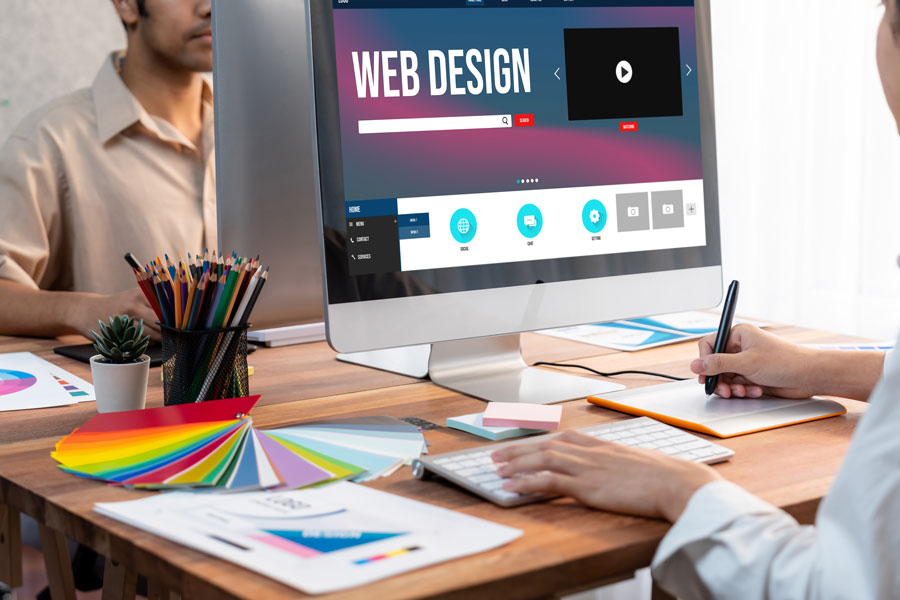
Responsive Website Design
Many businesses invest in a website, but without the right structure and strategy behind it, that website fails to generate leads, sales, or real business growth.
Website design determines whether visitors stay, engage, or leave. A well-structured site builds trust and drives action, while a poorly designed one quietly loses opportunities.
Design involves more than visual appearance. It includes layout, usability, navigation, responsiveness across devices, and the way information is structured and presented. Effective website design organizes content so visitors can quickly understand what a business offers and how to take the next step. The purpose is to create a platform that meets both the goals of the organization and the needs of its users, often in coordination with web development and custom programming.
A website often serves as the first point of contact between a business and potential customers. First impressions are formed rapidly, influencing whether visitors remain engaged or abandon the site. Design must immediately confirm that the visitor has arrived at a credible, relevant destination that can meet their needs.
User experience plays a central role in this process. Navigation should be intuitive, information should be easy to locate, and the interface should function smoothly across devices. Responsive design ensures usability on smartphones, tablets, and desktops, reflecting the reality that audiences now access websites through a variety of screen sizes.
Website design also reinforces brand identity. Visual elements such as color schemes, typography, imagery, and layout consistency contribute to recognition and trust. A cohesive design helps visitors associate the website with the organization’s values and professionalism, strengthening credibility and differentiation from competitors.
Beyond aesthetics, design influences performance and discoverability. Search engines favor well-structured, fast, and mobile-friendly websites, making design a factor in visibility and traffic acquisition. Clear organization and strategic placement of calls to action also support conversions by guiding visitors toward inquiries, purchases, or other desired outcomes, supported by search engine optimization and conversion optimization.
For many organizations, the website functions as a central hub connecting marketing, communication, customer service, and operations. It presents information, answers questions, captures leads, and supports transactions, making design decisions directly tied to business results.
SEARCHEN NETWORKS® approaches website design as a system that supports communication, marketing, and operational goals simultaneously. Instead of focusing solely on appearance, we evaluate how the website must function within the broader digital environment — including search visibility, user engagement, conversion pathways, and integration with other services such as website marketing.
Our process begins by understanding what the organization needs the website to accomplish. This includes identifying target audiences, defining primary actions visitors should take, and determining how information should be structured to support those objectives. Design decisions are guided by these goals rather than aesthetic trends.
We also consider long-term scalability. Websites must accommodate future content expansion, marketing initiatives, and technological changes without requiring complete reconstruction. By building flexible frameworks, organizations can adapt their digital presence as needs evolve.
Technical performance is another critical factor. Speed, responsiveness, accessibility, and compatibility across browsers and devices are essential for maintaining usability and credibility. Design choices are evaluated not only for visual impact but also for their effect on performance and reliability, often supported by stable website hosting and ongoing website support.
Integration with marketing efforts is also addressed. A well-designed website supports search engine optimization, advertising campaigns, analytics tracking, and content strategy, ensuring that marketing investments lead visitors to a platform capable of converting interest into action.
Website design continues to evolve as user expectations and technologies change. Modern audiences expect fast loading times, intuitive navigation, and seamless interaction regardless of device or location. Organizations that maintain effective design standards are better positioned to attract visitors, retain attention, and convert engagement into meaningful outcomes.
A well-executed website becomes a durable asset that supports growth, communication, and customer relationships. By presenting information clearly and facilitating interaction, it serves as a reliable foundation for digital operations in competitive markets.
General Services:
- Website Designer
- Web Design Specialist
- Freelance Web Designer
- Professional Website Design
- Corporate Website Designer
- Local Web Designer
- Remote Website Designer
Specific Services:
- Responsive Web Design
- E-commerce Website Designer
- Custom Web Design Services
- User Experience (UX) Designer
- User Interface (UI) Design Specialist
Tools and Technologies:
WordPress Designer
Shopify Design Expert
HTML5 Developer
CSS3 Specialist
JavaScript Web Designer
Feel free to request more information or call us right now at 561-370-7366 for a free strategic consultation.