



Adds Inclusion Of Merchant Marketing Emails And Expanded Content Analysis
WEST PALM BEACH, FL – Google is preparing to roll out updated terms for Google Merchant Center beginning June 15, 2026, marking the first major revision to the agreement in several years. While many merchants may dismiss the update as routine legal housekeeping, the changes appear to reflect something much larger: Google’s accelerating shift toward an AI-driven commerce ecosystem where merchant data extends far beyond simple product feeds.
Merchant Center has historically functioned as the platform where businesses submit product data feeds for use across Google Shopping, Search, ads, and related commerce services. However, the revised terms suggest Google increasingly views Merchant Center as a centralized merchant intelligence platform capable of powering AI-generated shopping experiences, automated summaries, recommendations, customer assistance, and future commerce tools.
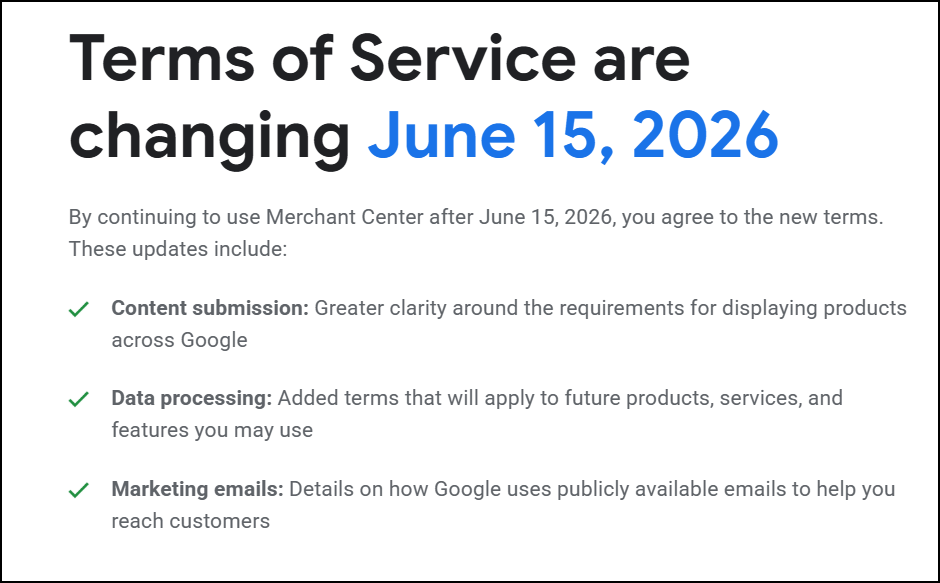
One of the most notable additions in the updated agreement involves Google’s explicit reference to merchant marketing emails. The prior version of the agreement primarily focused on URLs, websites, and submitted content. The updated language now states that if Google signs up for or accesses merchant marketing emails, those communications may also be analyzed and treated as content under the agreement.
In practical terms, this means promotional emails, product announcements, discount campaigns, seasonal sales messaging, support communications, and related merchant-generated content may increasingly become part of Google’s broader understanding of a business and its offerings.
The revised language also expands the definition of what Google may access, crawl, analyze, and cache. Beyond traditional webpages, the updated terms reinforce Google’s ability to retrieve and evaluate content connected to merchant destinations, including communications associated with submitted feeds and merchant ecosystems.
For businesses, this could have significant implications in the rapidly evolving world of AI-powered search and shopping.
As Google continues integrating AI-generated summaries, conversational search experiences, and automated product recommendations into its ecosystem, the company appears to be building a more comprehensive understanding of merchants that may include:
- Product catalogs and pricing
- Promotional offers and discounts
- Shipping and return policies
- Customer support information
- Merchant branding signals
- Inventory availability
- Website content
- Structured data
- Marketing language and promotional positioning
The changes arrive as Google increasingly transforms from a traditional search engine into what many industry observers view as an AI-assisted decision and recommendation platform.
Instead of merely displaying blue links to websites, Google’s newer AI experiences are designed to summarize information, answer questions directly, compare products, recommend businesses, and potentially guide consumers through purchasing decisions without requiring the user to visit multiple websites individually.
The Merchant Center updates appear consistent with that broader strategic direction.
Another important detail within the revised terms involves Google’s continued emphasis on automated testing, analysis, ranking adjustments, and content formatting experiments. While much of this language existed previously, the expanded ecosystem described in the updated agreement reinforces the reality that merchant visibility inside Google’s platforms is becoming increasingly dynamic, automated, and AI-influenced.
The revised agreement also introduces broader data processing language intended to support future products, services, and features. This addition suggests Google is attempting to future-proof the agreement for emerging AI commerce initiatives that may not yet be publicly announced.
For businesses that rely heavily on Google Shopping, Search visibility, or e-commerce traffic, the practical takeaway is clear: maintaining accurate, consistent, machine-readable business data is becoming more important than ever.
Inconsistent pricing, outdated product feeds, conflicting support information, inaccurate structured data, and disconnected branding across platforms may increasingly create problems not only for search rankings, but also for how AI systems interpret and present businesses to consumers.
The changes also reinforce a growing reality in digital marketing: AI systems are no longer simply indexing webpages. They are increasingly interpreting businesses holistically through feeds, structured data, communications, merchant policies, customer interactions, and other machine-readable signals distributed across the web.
While most businesses will likely click “accept” without reading the updated agreement, the revisions provide a revealing glimpse into how Google’s commerce ecosystem is evolving behind the scenes – and how AI may soon play a much larger role in determining how products, services, and businesses are discovered online.
Key Facts & Details
| Topic | Details |
|---|---|
| Effective Date | June 15, 2026 |
| Platform Affected | Google Merchant Center |
| Previous Major Version | Last modified October 24, 2022 |
| Major New Addition | References to merchant marketing emails and expanded content analysis |
| Broader Trend | AI-powered shopping, search summaries, and automated commerce experiences |
| Potential Business Impact | Greater importance on feed accuracy, structured data consistency, and merchant information alignment |
| Google Direction | Expanding from traditional search toward AI-assisted commerce and recommendation systems |
| Key Concern for Merchants | How AI systems may interpret and present merchant data across Google’s ecosystem |
 Enjoyed This Content?
Like our coverage of search, SEO, AI, and digital publishing? Add SEARCHEN NETWORKS® as a Google Preferred Source to discover more of our articles in Google Search.
Add SEARCHEN NETWORKS®