

Emphasis On Advertiser Trust, Brand Transparency, And User Satisfaction
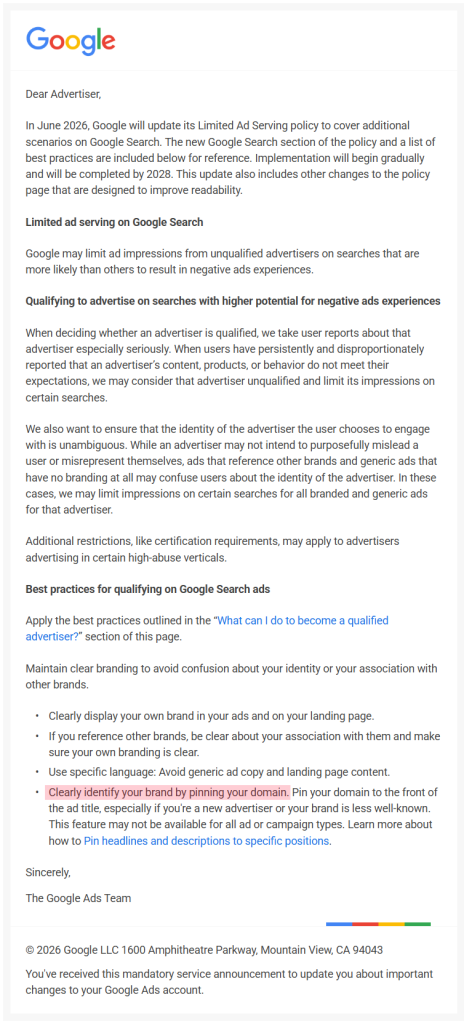
WEST PALM BEACH, FL – Google has announced a significant update to its Limited Ad Serving Policy that could affect how often some advertisers appear in Google Search results over the next several years. The change, announced on June 12, 2026, introduces new criteria that Google may use when determining which advertisers are qualified to appear on certain search queries.
While the rollout will begin gradually, Google says implementation will continue through 2028. For businesses that rely on Google Ads, the update signals a growing emphasis on advertiser trust, brand transparency, and user satisfaction.
What Is Changing?
Google’s updated policy states that it may limit ad impressions from advertisers it considers “unqualified” on searches that are more likely to result in negative advertising experiences.
According to Google, qualification decisions may be influenced by factors including:
- User complaints and reports
- Advertiser identity clarity
- Branding consistency
- Compliance within certain regulated or high-abuse industries
The company says it will pay particular attention to situations where users repeatedly report that an advertiser’s products, services, content, or behavior do not meet expectations. In practical terms, advertisers that generate an unusually high volume of complaints could see their ads shown less frequently on certain searches.
Google Wants Advertisers to Be Easier to Identify
One of the most notable parts of the update involves branding. Google specifically warns that advertisements referencing other brands or advertisements with little or no identifiable branding may create confusion about the advertiser’s identity.
While Google acknowledges that many advertisers are not intentionally trying to mislead users, it says ads that make it difficult for users to determine who they are engaging with may be subject to impression limitations.
This appears to be aimed at reducing confusion caused by:
- Generic lead generation advertisements
- Affiliate marketing campaigns
- Third-party resellers
- Advertisements that resemble another company’s branding
- Ads that fail to clearly identify the advertiser
For years, advertisers have focused on generic marketing headlines designed to maximize click-through rates. Google’s latest guidance suggests the company may increasingly favor advertisements that clearly identify the business behind the ad.
Why Google Is Recommending Domain Pinning
Google’s email also includes an unusual recommendation: advertisers should consider pinning their domain or brand name to the front of their ad headlines whenever possible.
For example, Google would likely prefer:
SEARCHEN.com | Search Engine Marketing & AI Visibility Services
instead of:
#1 Search Engine Marketing Company
The first example immediately identifies the advertiser, while the second provides little information about who is behind the advertisement. Although Google has not stated that domain pinning will directly improve ad performance, its inclusion in the guidance suggests advertiser identification is becoming increasingly important.
A Larger Trend Toward Trust and Transparency
This policy update appears to be part of a broader shift occurring across Google’s ecosystem.
Over the past several years, Google has invested heavily in:
- Advertiser verification programs
- Business profile verification
- Enhanced disclosures
- Reputation systems
- Spam reduction initiatives
- AI-powered search experiences
As Google continues integrating artificial intelligence into Search, it has become increasingly focused on understanding real-world entities and trusted brands rather than simply evaluating keywords and bids.
The Limited Ad Serving update reflects that evolution.
Google is signaling that trust, transparency, and advertiser identity may play a larger role in determining ad visibility moving forward.
What Advertisers Should Do Now
Businesses running Google Ads campaigns should consider reviewing their campaigns and landing pages to ensure that:
- Company branding is clearly visible
- Advertisements accurately represent the business
- Landing pages clearly identify the advertiser
- Brand names are included in ad copy when appropriate
- User complaints and customer satisfaction issues are addressed promptly
Advertisers operating in competitive or highly regulated industries should pay particular attention, as Google notes that additional restrictions and certification requirements may apply in certain sectors.
Key Takeaway
Although Google describes this as a policy update, it could represent a meaningful shift in how advertising visibility is managed on Google Search. The company is moving beyond traditional factors such as bids, quality scores, and landing page relevance by placing greater emphasis on advertiser reputation and identity.
For legitimate businesses with strong branding and positive customer experiences, the update may provide an advantage. For advertisers that rely on generic messaging, unclear branding, or practices that generate frequent complaints, visibility could become more difficult over time.
With implementation continuing through 2028, businesses have time to prepare – but the message from Google is becoming increasingly clear: advertisers should make it easy for users to know exactly who they are doing business with.
 Enjoyed This Content?
Like our coverage of search, SEO, AI, and digital publishing? Add SEARCHEN NETWORKS® as a Google Preferred Source to discover more of our articles in Google Search.
Add SEARCHEN NETWORKS®