
Expands Types of Information Saved When Users Interact with Search Services
WEST PALM BEACH, FL – Google’s latest update separates Search activity from Web & App Activity and expands the types of information that may be saved when users interact with Search services. Google has begun notifying users about a significant change to how Search-related activity is managed within Google Accounts. While the update is being presented as a new set of privacy controls, it also reveals how Google Search is evolving beyond traditional keyword searches into a platform increasingly powered by artificial intelligence, visual search, voice interactions, and multimedia content.
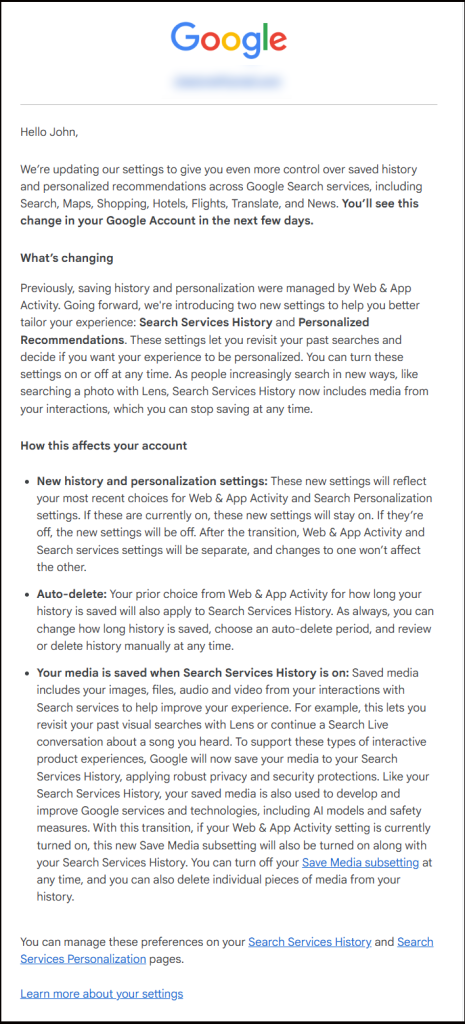
The company announced that it is introducing two new settings called Search Services History and Personalized Recommendations, which will gradually replace the Search-related portions previously managed under Web & App Activity.
For many users, the change may appear minor. However, the details suggest Google is preparing for a future where searching involves much more than typing words into a search box.
Search Is No Longer Just About Keywords
For decades, Google Search primarily revolved around text-based queries. Today, users are increasingly interacting with Google’s ecosystem through tools such as Lens, voice search, AI-powered conversations, image recognition, file uploads, and multimedia searches.
According to Google’s notification, Search Services History may now include media associated with user interactions, including:
- Images
- Audio recordings
- Videos
- Files uploaded during Search interactions
Google says these features are designed to improve the user experience by allowing people to revisit previous searches, continue conversations, and access information from earlier interactions. For example, a user who uploads a photograph to Google Lens may be able to revisit that visual search later. Likewise, users participating in AI-powered Search experiences may be able to continue previous conversations or interactions.
The Introduction of “Save Media”
Perhaps the most notable aspect of the update is a new sub-setting referred to as Save Media. Google explains that media associated with Search interactions may be stored when Search Services History is enabled. This includes images, files, audio, and video content used during interactions with Google’s Search services.
The company states that this information may be used to support interactive Search features and improve Google products and technologies, including artificial intelligence systems and safety measures. For privacy-conscious users, this represents one of the most important parts of the announcement.
While Google emphasizes that users can disable these settings or delete stored activity, many people may not realize that multimedia content used during Search interactions could now be saved as part of their Search history.
What Happens to Existing Settings?
The transition will not immediately change the preferences users already have in place. According to Google, the new Search Services History and Personalized Recommendations settings will initially inherit existing preferences from Web & App Activity and Search Personalization.
In practical terms:
- If Web & App Activity is currently enabled, Search Services History will likely be enabled as well.
- If Search Personalization is currently enabled, Personalized Recommendations will remain enabled.
- Existing auto-delete settings will carry over to the new Search history controls.
Google says users will retain the ability to review, delete, or automatically remove stored activity after a selected period.
The Future of Search
While Google is framing the change as an update to privacy controls, the larger story may be what it reveals about the future of Search itself. The company’s announcement repeatedly references visual search, Search Live experiences, media uploads, and other forms of interaction that go far beyond traditional search behavior.
As AI-powered experiences become more integrated into Search, Google appears to be building the infrastructure needed to support persistent conversations, visual searches, voice interactions, and multimedia content across its ecosystem. In many ways, this update reflects a broader shift underway across the technology industry. Search engines are increasingly becoming AI-driven discovery platforms where users communicate through images, audio, documents, and conversations instead of simple keyword queries.
The creation of dedicated Search Services History controls suggests Google expects these interactions to become a much larger part of how people use Search in the years ahead.
What Should Users Do?
Users who receive Google’s notification may want to review their account settings and determine whether they are comfortable with Search Services History and Save Media being enabled. While some users may appreciate the convenience of revisiting visual searches, continuing AI conversations, or accessing previously uploaded content, others may prefer to limit the amount of information stored within their accounts.
The new controls give users more visibility into what Search-related information is being retained, but they also serve as a reminder that modern search experiences increasingly involve much more than the words typed into a search box. As Google continues to blend Search with artificial intelligence, the question for users becomes increasingly simple:
Do you want Google storing images, audio, files, and videos used in Search?